Why Q4 Is the Smartest Time to Start Outbound Prospecting

Every fall, business owners say some version of the same thing:
“We’ll pick sales back up in January.”
It sounds practical. People travel. Budgets get reviewed. Decision-makers disappear for stretches of time. Staff members shift into year-end mode. So the sales push gets postponed until the calendar flips.
That choice feels harmless in October. By January, it often becomes expensive.
After more than 20 years of cold calling and prospecting, I have seen the pattern repeat. Companies that stop calling in Q4 start the new year chasing from behind. Companies that keep making calls through October, November, and December start January with names, needs, next steps, and real conversations already in motion.
The work that fills a January pipeline rarely starts in January. It starts months earlier.

Your January pipeline is built in October
Most B2B sales do not close after one call.
A typical deal starts with a first conversation. That leads to a scheduled meeting. The meeting may lead to a second conversation with another decision-maker. Then comes a proposal, review, internal discussion, approval, and signature.
Even in a simple sale, that process takes time. In a more complex sale, it can take weeks or months.
That timing matters.
If prospecting starts on January 2, the first meaningful meetings may not happen until mid or late January. Proposals may not go out until February. Closed business may not arrive until March or later.
That leaves a gap in the first quarter, right when most companies expect a strong start.
The math is plain: the calls that create January and February revenue often need to happen in October and November.
Q4 outbound prospecting is not about forcing people to buy during the holidays. It is about starting the right conversations early enough that they have time to mature. A call in October can become a discovery meeting in November, a proposal in December, and a signed agreement in January.
When that happens, the new year does not begin with panic. It begins with momentum.
Q4 is quieter, and that helps serious prospectors stand out
Many salespeople slow down in the fourth quarter.
Some assume no one wants to talk. Some get distracted by holiday schedules. Some believe buyers are too busy with year-end work. Others decide to “start fresh” in January because it feels cleaner and easier.
That creates an opening.
When fewer companies are calling, the ones that do call are easier to notice. Decision-makers are not always buried under the same volume of outreach they will see in January, when every sales team comes back with new goals and a fresh quota.
January is noisy. Q4 is often more open.
That does not mean every prospect will answer. It does not mean every buyer is ready. It does mean the field is less crowded.
A well-timed, respectful call in November can stand out more than that same call in the second week of January, when inboxes are full, voicemail boxes are packed, and everyone is “checking in.”
This is one reason Q4 is the smartest time to start outbound prospecting. You are not waiting in line with everyone else. You are getting there before the rush.

Buyers are already thinking about next year
The belief that “nobody buys in Q4” is too simple.
Some buyers do pause. Some budgets are locked. Some teams delay decisions until after the holidays. That is real.
But many decision-makers are actively thinking about the next year during Q4. They are reviewing what worked. They are looking at what failed. They are considering new vendors, new support, new systems, new processes, and new goals.
A prospect may not sign today, but they may be very willing to talk about what needs to change.
That is valuable.
A fourth-quarter call might uncover:
A contract that renews in January
A vendor relationship that has become frustrating
A project planned for the first quarter
A budget discussion happening before year-end
A problem the company wants to solve after the holidays
A decision-maker who wants options before the new year starts
Those conversations are not wasted because they do not close immediately. They give you context. They give you timing. They give you a reason to follow up with purpose.
A weak January call sounds like this:
“Just checking in to see if you need anything this year.”
A stronger January follow-up sounds like this:
“When we spoke in November, you mentioned that your team wanted to revisit this after year-end. You were looking at options before your current agreement renews. Is now still a good time to compare next steps?”
That second call has weight because the first conversation already happened.
Waiting until January creates false urgency
January feels like a fresh start, but it can create pressure that leads to bad sales habits.
When the pipeline is empty, every conversation feels heavier than it should. Salespeople chase too hard. They follow up too often. They push prospects who are not ready. They overvalue weak opportunities because there are not enough real ones.
That kind of urgency is not productive. Prospects can feel it.
The better approach is to enter January with a mix of active conversations:
If you stop in Q4 | If you keep prospecting in Q4 |
January starts with cold lists | January starts with warm follow-ups |
Sales activity feels rushed | Sales activity has direction |
First meetings happen late | First meetings are already booked |
Revenue may slip into spring | Q1 has a better chance to start strong |
The difference is not luck. It is timing.
A healthy pipeline gives you room to qualify properly. You can ask better questions. You can walk away from poor fits. You can focus on prospects who have a real need and a real reason to talk.
That is hard to do when January starts at zero.
Q4 calls are useful even when people are not ready to buy
Outbound prospecting is often judged too narrowly. If a prospect does not buy right away, some teams see the call as a failure.
That is the wrong view, especially in Q4.
A good prospecting call can produce many useful outcomes besides an immediate sale. It can confirm the right contact. It can reveal when a contract ends. It can identify who handles the decision. It can uncover a pain point. It can set a better follow-up date.
Those details are the raw material of a strong pipeline.
In October, November, and December, your goal is not to pressure every prospect into a year-end decision. Your goal is to sort the market.
Who has a need now?
Who will have a need next quarter?
Who is locked in and not worth chasing?
Who is the real decision-maker?
Who should be removed from the list?
That is valuable work.
A call that ends with “reach back out in February” is not a dead end if the timing is real and the need is clear. It becomes part of your January and February plan.
A call that confirms “we are not a fit” also has value. It keeps your team from wasting time later.

The fourth quarter rewards consistency more than intensity
Some companies hear “prospect in Q4” and think it means making a frantic push during the last two weeks of December.
That is rarely the answer.
The real advantage comes from steady activity over time. A manageable daily calling rhythm in October, November, and December will usually do more than a short burst after the holidays.
Consistency works because prospects are not all available at the same moment. One person answers in October. Another replies in November. Another is out until early December. Another asks for a call after Thanksgiving. Another wants to reconnect in January.
If you only call during one narrow window, you miss too much.
A simple Q4 prospecting rhythm might look like this:
Keep a daily call block on the calendar
Prioritize prospects that match your best customer profile
Ask about plans, timing, and current challenges
Record specific follow-up dates
Send brief follow-up notes after useful conversations
Revisit warm prospects before the year ends
Enter January with a clear list of next steps
The key is to avoid treating Q4 like dead time. It is not dead time. It is setup time.
Your message should match the season
The fourth quarter is not the time for a generic pitch.
Prospects can tell when a caller is simply trying to squeeze in one more sale before year-end. That approach creates resistance.
A better message fits the moment. It acknowledges timing without making excuses for it.
For example:
“I know this is a busy time of year, so I’ll be brief. We work with companies that are reviewing plans for next year and want to solve this before Q1 gets moving. Is this something on your radar for the coming months?”
That kind of opener does a few things well.
It respects the prospect’s time. It connects the call to planning rather than pressure. It makes room for a real answer.
The best Q4 calls are calm, direct, and useful. They do not try to manufacture urgency. They look for real timing.
Good questions can help:
“Is this something your team is reviewing before year-end?”
“Do you already have a plan in place for next quarter?”
“When do you usually evaluate this kind of service?”
“Who else weighs in when you make this decision?”
“If it made sense, would January be a better time to revisit this?”
Those questions help separate curiosity from opportunity.
The January rush is too late for many deals
January feels busy in sales because everyone returns with energy. The problem is that activity and pipeline are not the same thing.
A team can make many calls in January and still be behind. If every conversation is brand new, the company is only starting the sales cycle. That activity may pay off later, but it will not fix a weak first quarter.
Q4 activity changes that.
By January, you can already know:
Which prospects asked for a follow-up
Which companies have a budget window
Which contacts are the right ones
Which needs are urgent
Which opportunities are not worth pursuing
Which meetings should be booked first
That information creates speed.
Instead of spending January figuring out where to begin, you begin with a plan. Instead of calling cold from a blank list, you continue conversations that started weeks earlier.
That difference can shape the entire quarter.
What to do before the year ends
If the fourth quarter is already underway, there is still time to build momentum. Start with practical steps.
Review your best-fit prospects first. Do not waste Q4 calling every name in a database. Focus on companies that match the problems you solve best.
Clean your list as you go. Bad numbers, wrong contacts, and poor-fit accounts slow everything down. Every call should make the list better.
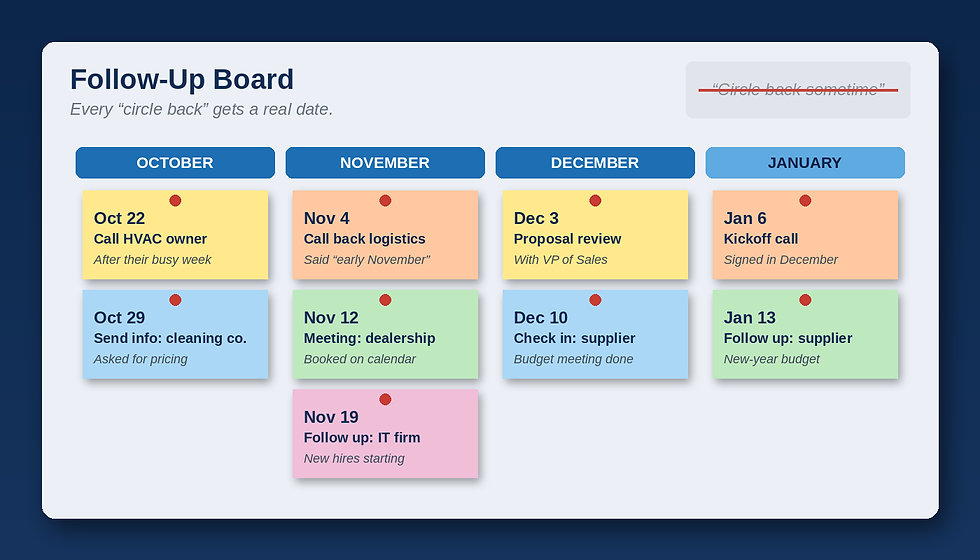
Set follow-up dates based on real timing. “Call back later” is too vague. “Follow up the week of January 8” is useful.
Keep notes short but specific. Capture the problem, timing, decision-maker, and next step.
Stay active between holidays. The calendar may be uneven, but there are still productive calling days in November and December.
Most of all, do not disappear. A steady presence in Q4 makes it easier to be remembered in Q1.
Start before everyone else starts
The businesses that win January often did the work before January arrived.
They called while competitors waited. They listened while others assumed nobody wanted to talk. They built follow-up lists while other teams postponed the hard work. They entered the new year with conversations already alive.
That is the real advantage of Q4 prospecting.
You do not need to close every deal before December 31. You need to create enough meaningful conversations so January starts with direction instead of guesswork.
If the plan is to grow in the new year, do not wait for the new year to begin selling.
Pick up the phone in October. Keep calling in November. Stay visible in December.
Your first-quarter pipeline will show the difference.


Comments